
Calhoun County Bench Warrants Explained
Think of a bench warrant as the court calling someone back on its own authority. A judge signs it, not a prosecutor, and the usual triggers are a skipped hearing, ignored court order, or unmet condition on a stayed sentence. Calhoun County sorts bench warrant questions by which court holds the file. Misdemeanors, traffic, and city ordinance cases belong to the 10th District Court. Felonies, family matters, and juvenile files belong to the 37th Circuit Court. Friend of Court handles support and custody enforcement, while Judicial Enforcement takes court debt. Note: a bench warrant is court process, and the underlying case is a separate question with its own answer.
The Michigan 48-Hour Rule After a First Failure to Appear
Michigan court rules build a short pause into a first missed criminal appearance. The court generally waits 48 hours before issuing a bench warrant, and weekends and holidays when the court is closed do not count toward that span. A judge may also reschedule the matter when good reason exists. The rule carves out exceptions. A prior failure to appear, a serious circumstance in the case, or a reason the judge states for acting right away can shorten or skip the wait. During the waiting period, the rule also limits revoking release and forfeiting bond. Rule language can change, so read the current text instead of trusting a summary. The Michigan Court Rules carry Chapter 6, which holds the failure-to-appear provisions a Calhoun County defendant or family member will want in hand.
How Calhoun County Bench Warrants Are Issued
Every Calhoun County courtroom follows the same basic path when a warrant issues. The case appears on the docket. The person does not show up. The judge then makes a record of what happens next, and that record becomes the basis for the warrant while the clerk's office prepares the paperwork that goes to law enforcement. A first criminal failure to appear triggers the waiting rule described above. A violated order in a family or support case takes a different route, running through the enforcement side of the family division with its own form and its own hearing history. Three questions help anyone facing this: whether a warrant was issued, on what date, and what the court requires to clear it. The clerk can answer all three for a Calhoun County case.
Friend of Court Enforcement Warrants
Support and custody cases produce enforcement warrants that look quite different from a criminal bench warrant. The state's blank FOC 14 form shows the structure plainly. It lists the court, the case number, the judge, a police report number when one exists, the parties named in the caption, reason checkboxes, identifying details for the person, a cash performance bond line, the judge's signature, and return instructions for the officer. The reason boxes cover a failure to appear at a show-cause hearing and a failure to satisfy the conditions of a stayed commitment order. Friend of Court handles those files in Calhoun County, and the office answers enforcement questions at 269-969-6500. Do not treat the form as a general criminal template. It belongs to family enforcement, and the county routes it separately for that reason.
Bench Warrants and Arrest Warrants Compared
A Calhoun County bench warrant and an arrest warrant reach a similar piece of paper by different paths. Knowing which one you face shapes what to do next.
| Point | Bench Warrant | Arrest Warrant |
|---|---|---|
| What starts it | A missed appearance or violated order | A sworn complaint and probable-cause review |
| Who issues it | The judge already handling the case | A judge or magistrate after a new accusation |
| Court most often involved | Whichever court held the case | Circuit or District, depending on the charge |
| Practical effect | Returns a person to an existing case | Answers a new allegation |
| Usual first call | Clerk of the court on the notice | Issuing court, then counsel |
District Court or Circuit Court: Which Clerk to Call
The court named on your original paper is the court that holds the warrant. A ticket or notice naming the 10th District Court means that clerk answers whether a failure to appear produced a warrant, and the traffic or criminal desk will say what comes next. Paperwork naming the 37th Circuit Court goes to the Circuit Clerk instead. Both courts sit in the Justice Center at 161 E. Michigan Avenue in Battle Creek, and the 10th District Court page lists its desk hours. Confirm the desk schedule before you travel, since District hours differ from clerk-counter hours in Calhoun County.
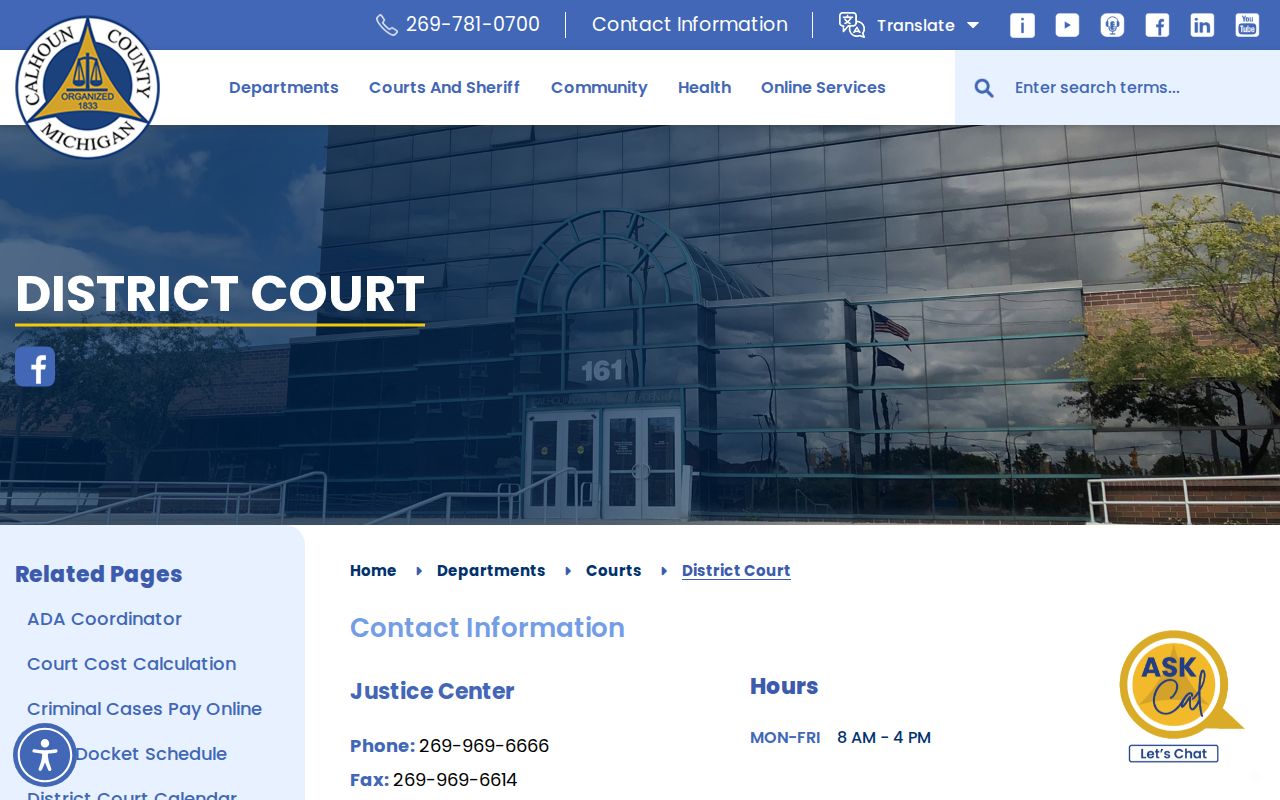
The 10th District Court page carries the case search, calendar, payment, and probation links a Calhoun County bench warrant question usually touches. Note: a calendar entry identifies a court event, and it does not state whether a warrant is active.
Resolving a Calhoun County Bench Warrant
Clearing a Calhoun County bench warrant starts with the issuing court, not a payment screen. Confirm the court and case number first. Then ask whether the warrant is open, whether the court wants a motion to recall or quash it, and whether a same-day appearance is possible.
Caution: paying a balance does not automatically recall a bench warrant in Calhoun County. The court, not the payment vendor, decides whether the warrant clears.
Ask about counsel before you appear in Calhoun County court. A lawyer can file the motion, explain what the judge is likely to require, and keep a planned surrender from turning into a surprise. Follow the court's instruction exactly, and ask for written or docket confirmation once the matter is addressed. If a bench warrant becomes an arrest, Michigan court rules require prompt handling and an arraignment, which is when release conditions get set.
What to Ask Before a Walk-In Surrender
Planning to turn yourself in on a Calhoun County warrant? Start with a phone call. The county's warrant page tells people to contact the right court or agency before walking in, and it promises nothing beyond that: no set surrender window, no guaranteed hearing slot, no standard release outcome. No amnesty calendar exists here either. One more caution belongs on the list. A blank answer from one office is not the final word on whether a Calhoun County warrant stands; only the issuing court can confirm it.
When you reach the clerk, ask where to report, what to bring, whether a lawyer should arrange the appearance, and whether a bond has been set. Verify with the office you will actually enter, since the court building and the jail sit at two different addresses. At the Justice Center, security applies outside scheduled hearings too: weapons are barred, devices must be silenced in a courtroom, and recording without permission is not allowed. Many hearings happen by video, so let the notice decide whether you appear in person.
Finding the Court That Issued the Warrant
Lost the notice? The case number can carry the load. Run it through the state's public case search, then match the court that appears against the phone list below. A court of record simply means the court holding the official file. That office's answer is the one that counts for a Calhoun County warrant lookup. For felony, family, and juvenile files, the Circuit Clerk's contact panel below is the starting point, and it lists the same building address the District Court uses.
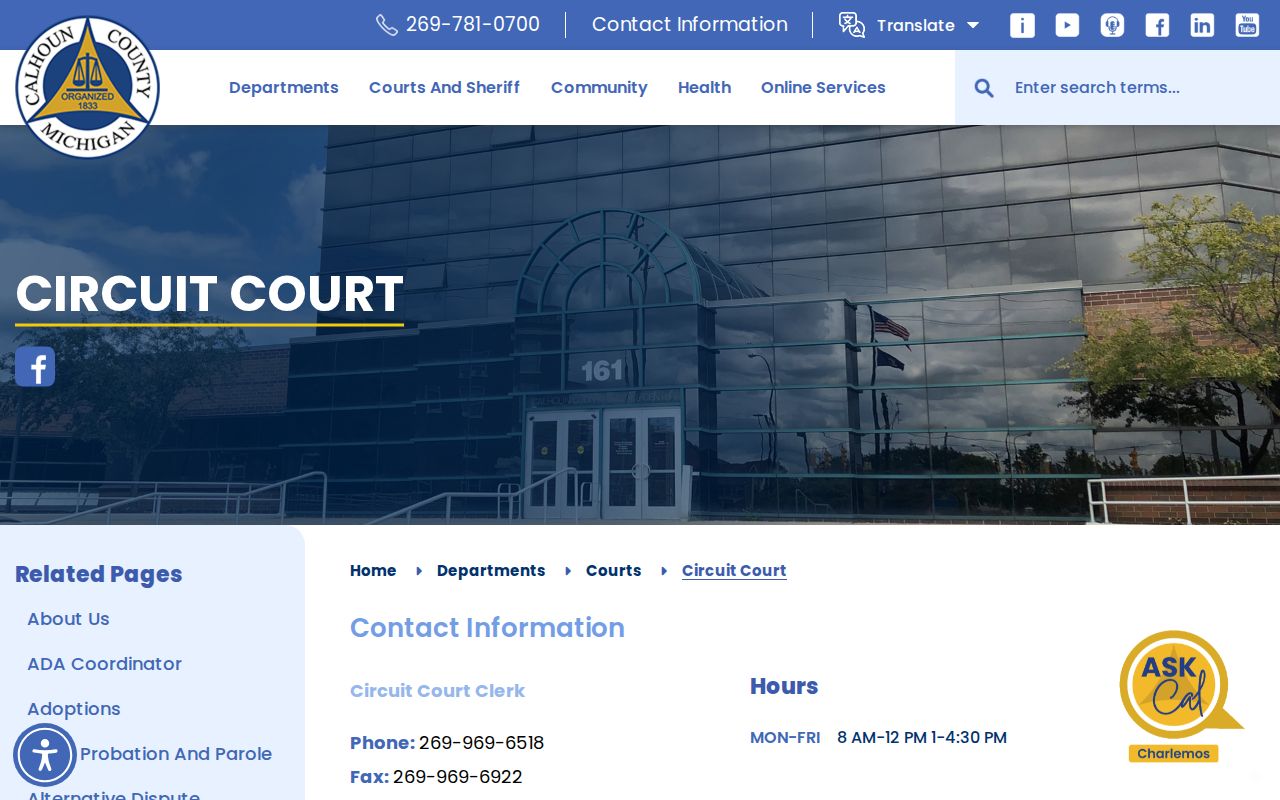
For Calhoun County files of that kind, call the 37th Circuit Court at 269-969-6518. Traffic, misdemeanor, and ordinance matters go to the 10th District at 269-969-6666.
No Calhoun Amnesty Day: Ask About Recall Procedure
Some counties hold warrant roundups or amnesty dockets. Calhoun County does not. Battle Creek, Albion, Marshall, and Springfield publish no such program, no recall clinic, and no walk-in no-arrest calendar. Michigan's license-suspension reforms eased some driving consequences, but court obligations still stand. That gap is not bad news. It points you straight to the clerk. Ask the issuing court's clerk how a recall works here: by motion, by appearance, by payment, or through a collections review, and what the filing requires. Remember that a nearby county's roundup is never a Calhoun County program, and no social post creates one.
Note: only the issuing court can confirm, recall, or quash a warrant.